Dr. Gymbro
←

#heart rate variability

2 articles
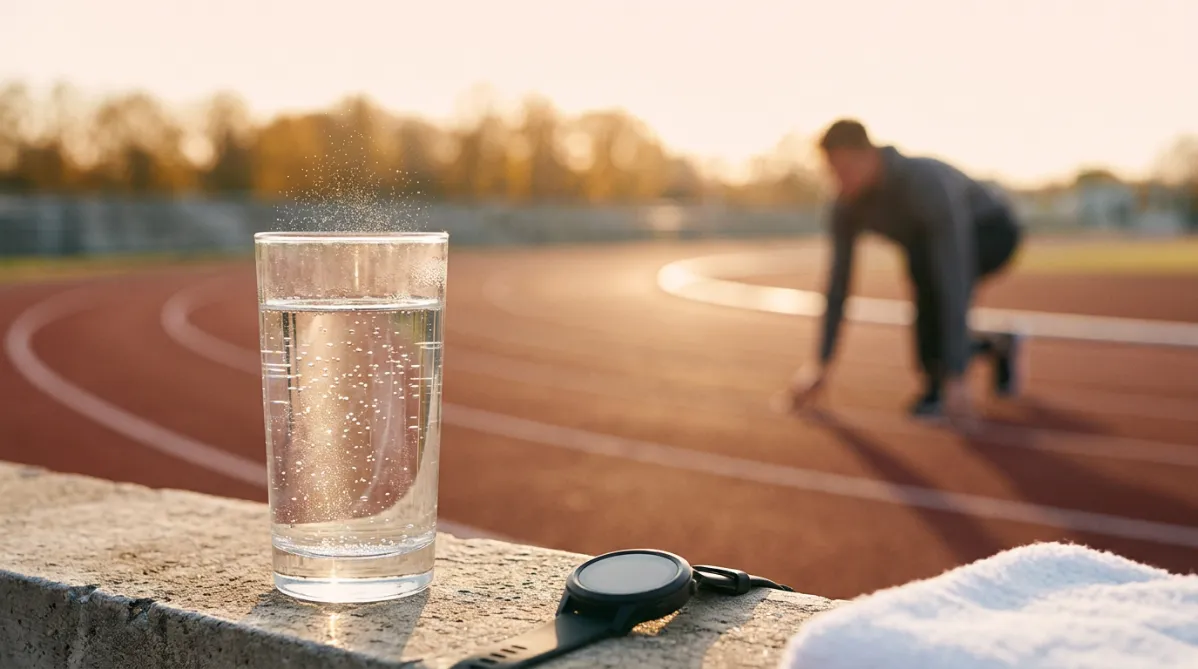
A wide, editorial-style photograph of a clear glass of water on a weathered concrete ledge at the edge of an outdoor running track, shot in soft golden-hour light. Tiny, fine bubbles cling to the inside of the glass and drift upward, catching warm backlight so the water looks luminous and crisp. The glass is about three-quarters full, with delicate condensation beading on its surface. In the softly blurred background, the curved lanes of a terracotta-red track sweep diagonally across the frame, with faint white lane lines leading toward the horizon. A lone sprinter in a charcoal athletic top crouches in a starting position, out of focus, rendered as a muted silhouette. Long shadows stretch across the track, and a hazy line of trees glows amber in the distance.

Foreground details are sharp: a matte black sports watch rests beside the glass, its screen dark, and a folded white towel sits at the edge of the frame. The palette is warm and restrained, with terracotta, sand, soft peach sky, charcoal, and the cool, clean glint of water as the focal accent. Shallow depth of field, 85mm lens look, fine film grain, gentle natural lens flare from the low sun. The composition follows the rule of thirds, with the glass placed on the left third and generous negative space on the right for headline text. The mood is calm, athletic, and modern, like a contemporary health and performance magazine cover, with no text, logos, or futuristic elements.
science research

Wasserstoffreiches Wasser vor Sprinten: Leistung erhalten und Erholung beschleunigt

BY DR. GYMBRO ·

Ein einziges 280‑ml‑Glas wasserstoffreiches Wasser, etwa eine Minute vor einem All‑Out‑Sprint getrunken, hielt die Leistungsabgabe in einer Crossover‑Studie höher. Die Athleten erholten sich zudem schneller, gemessen an der Herzfrequenzvariabilität, und das Blutlaktat war drei Minuten nach dem Training etwa 1 mmol/L niedriger. Die Untersuchung umfasste jedoch nur 13 Männer, war einfach‑blind und testete lediglich eine akute Dosis. Hier erfahren Sie, was die Forschenden herausfanden, wie sie dosierten, für wen es geeignet sein könnte und warum Skepsis angebracht ist.

A wide, editorial-style still life photographed on a pale warm-gray concrete surface in soft, diffused morning window light. On the left side, a tall clear glass filled with deep magenta-crimson beetroot juice sits beside two halved raw beetroots, their concentric rings of vivid fuchsia and purple clearly visible, with a few small green-and-red-veined leaves draped casually nearby. On the right side, a matching clear glass of cloudy white creatine solution rests next to a small matte ceramic bowl heaped with fine white powder and a minimal wooden scoop, a light dusting of powder scattered across the surface. In the center, between the two sides, a simple matte black barbell grip and a single chalk-dusted weight plate edge rise into the frame at a low angle, hinting at lifting without showing a person. The composition is split in a balanced, symmetrical way, with a subtle vertical shadow line dividing the saturated magenta tones on the left from cool, neutral whites and creams on the right. The background is softly blurred with a muted sage-green and oatmeal-toned wall, with plenty of negative space at the top for a headline overlay. Shallow depth of field, crisp focus on the glasses' condensation droplets and the textured beetroot flesh. The color palette is limited and refined: magenta, cream, charcoal, and soft sage. The mood is clean, modern, and health-journal chic, like a contemporary wellness magazine cover, with natural shadows, a tactile matte finish, and subtle film-like grain. No text, no logos, no futuristic elements.
nutrition

Rote‑Bete‑Saft vs. Creatin: Wer gewinnt beim Heben in 72 Stunden?

BY DR. GYMBRO ·

Eine neue randomisierte Crossover‑Studie stellte Rote‑Bete‑Saft und Creatin bei unerfahrenen Kraftsportler*innen über ein etwa 72‑Stunden‑Supplementationsfenster gegenüber. Creatin erzielte die höhere Wiederholungszahl beim Bankdrücken mit 80 % des 1‑RM, während Rote‑Bete‑Saft bei Stangengeschwindigkeit, Muskeloxygenierung, maximaler Herzfrequenz und HRV‑Erholung besser abschnitt. Das Abstract nennt weder Dosierung noch Einnahmezeitpunkt – diese Lücken markieren wir. Im Folgenden die vollständige Scorecard und Hinweise, welches Supplement für welche Ziele sinnvoll sein könnte.

This page is available in